 Meeting champagne makers is always a fascinating experience, but although they all have a huge amount of experience and knowledge to share, some are much better at explaining things than others; that’s why it’s such a pleasure spending time with Didier Gimonnet of Champagne Pierre Gimonnet in Cuis. Not only does he make fabulous champagne, but he talks about it and about champagne in general with ease, authority and humour.
I was with him last Saturday when, with 3 guests, we tasted almost the entire range.
Didier explained that when he and his brother Olivier took over the management of the family business from their father, he left them few instructions. Most of the knowledge their father had accumulated over his lifetime working in the vineyards and making champagne was contained in a precious little notebook which he handed to the boys and pretty much said : “Here’s all you need to know, now just get on with it.”
In it are all M. Gimonnet senior’s notes on each of the harvests he knew in his lifetime. Of course Didier still has the notebook; its secrets remain for the family’s eyes only but here’s a glimpse of just one page.
Golden nuggets
What else did I learn? Lots and too much to put it all down in just a few lines, but here are some of the little nuggets of information I gleaned.
Didier doesn’t entirely subscribe to the theory that small yields are necessarily better. Some people would have it that a small harvest, with fewer grapes, is desirable because it produces greater ripeness in the grapes and therefore more intensity in the aromas and flavours of the champagne.
Didier’s opinion, if I can summarise it accurately, is that Champagne is too far north to give the level of ripeness that will produce really intense flavours, even in a very good year. Besides, champagne is not about intense ripeness; champagne must have a certain level of acidity to give the wine freshness and vivacity and you are more likely to find these qualities in a more abundant harvest.
To put it into concrete terms, in Didier’s view the ideal range for the yield is between 50 – 75 hectolitres per hectare, or if my calculations are correct, between 8,000 and 10,000 kg of grapes per hectare.
|
YIELD PER HECTARE
|
|
Kg
|
Hectolitres
|
Litres
|
Bottles
|
|
160
|
1
|
102
|
136
|
|
4,000
|
26
|
2,550
|
3,400
|
|
8,000
|
51
|
5,100
|
6,800
|
|
10,000
|
64
|
6,375
|
8,500
|
|
12,000
|
77
|
7,650
|
10,200
|
Grand Crus
What else did I learn?
Well for one thing, I learned that there were originally only 4 Grands Crus villages: Ay and Verzenay for Pinot Noir and Avize and Cramant for Chardonnay. Le Mesnil-sur-Oger , for example,only became a Grand Cru in 1982
I learned that on La Côte des Blancs, Avize, Cramant and Chouilly lend finesse to a blend whereas wines from Oger and Le Mesnil-sur-Oger bring more power with minerality and even a slightly smokey touch.
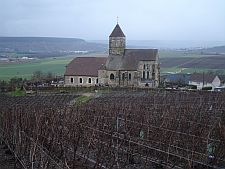 Cuis on the other hand, has the highest acidity of all the villages in La Côte des Blancs and because the style of Pierre Gimonnet champagnes is very much that of the northern part of La Côte des Blancs, there is always a proportion of wines from Cuis in their blends.
"I am not a wine maker"
Didier’s view is that the chefs de caves at the large champagne houses have to be real wine makers.
Their brief, at least for the majority of their champagnes, is to produce the same quality and same house style year in, year out. They take the grapes and the juice from a wide selection of different villages and grape varieties and they have to mould those ingredients to make the style of wine they already have clearly fixed in their minds and for which the house is famous.
The smaller producers such as Pierre Gimonnet, don’t have the breadth of supply to pursue the same strategy.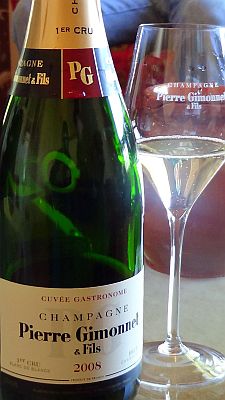
Smaller producers usually have grapes from a fairly limited number of villages, often quite close to one another. There is not sufficient diversity to mould the wine to a model set by the wine maker. Consequently the smaller producers must adapt themselves to what the vineyards give them, not the other way round.
That’s why Didier doesn’t call himself a wine maker; his role is more to let the terroir express its full potential even if that means slight differences in the champagne from one year to the next.
The price of champagne - something’s got to give
It’s undeniable that consumption of champagne in some markets has declined in recent years due mainly to the sluggish economy. On the other hand more countries are acquiring the taste for champagne and on a global scale demand for champagne is on an upward trend, and that is certainly true is we look a few years into the future.
I can’t help thinking therefore that the days are numbered when you can still find champagne in supermarkets and the like at bargain basement prices.
Just look at these figures that Didier Gimonnet shared and you’ll see what I mean.
In the past 10 years
- The price of a hectare of vines in Champagne has increased 70-80%
- The prices of a kilogram of grapes has increased by 20%
- The average selling price of a bottle of champagne has increased by just 1%
That is not a sustainable situation and it seems that there must inevitably be a price increase.I’d stock up now if I were you.
So what’s the conclusion?
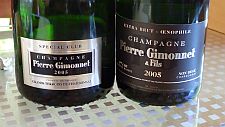 I suppose it’s that no matter how much you think you know about champagne, you still don’t really know at all.
No matter what trend or fashion there seems to be, whether it is the tendency to produce low dosage wines, or to extol the virtues of small harvests, there is always another point of view and always more to discover.
Oh well. We may never become masters of champagne, but we all have the consolation of knowing that there will always be a lot more tasting and sampling to be done.
Stay Bubbly
Jiles


 Have you ever seen people open a champagne bottle with a sabre? It looks pretty impressive doesn’t it? Yet when it comes to doing it yourself, it’s something that most people are really apprehensive about
 Champagne Philippe Brugnon in tucked away in a quiet street in the village of Rilly-La-Montagne and you’d never find it unless you knew where to go. There’s no sign on the gate, or the door and everything is very low key. Inside however you are in for a treat.
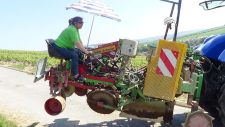 I came across a weird machine the other day.
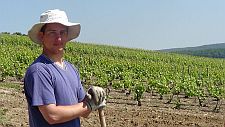 Take a look at the video and see if you can guess what they are doing before the answer appears on the screen.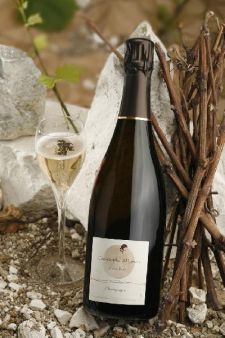
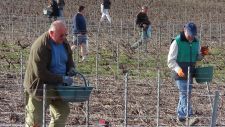 I thought that title might grab your attention, but now that I have it perhaps I am going to disappoint you, because this article and video may not be about quite what you think it is about. It’s more to do with the environment in fact, although sex does come into it.