


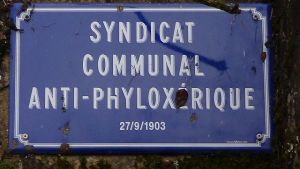
 I came across this sign recently when I passed through the village of Villers-Marmery and it prompted me to do a little research into what happened in Champagne a century and more ago when phylloxera devasted the vineyards.
It’s been such a long time since the phylloxera catastrophe ( no that’s not too strong a word) laid waste the vineyards not just in France but across the whole of Europe that many people these days have never even heard the word let alone know what it means.
Phylloxera (Daktulosphaira vitifoliae to give it its scientific name – it is also known as Phylloxéra vastatrix) is a small insect that attacks the roots of vines and eventually so weakens the plant that it dies.
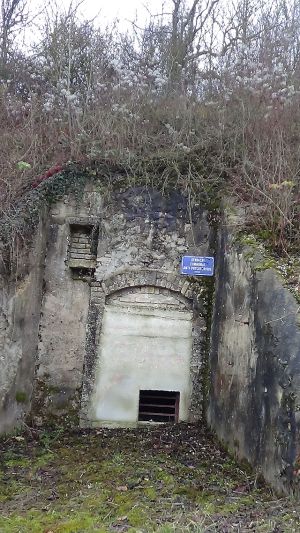 It is believed that the bug somehow made its way across the Atlantic Ocean from the USA, possibly in a consignment of timber or some other wooden product. The insect was first notice in France in 1868 in the Languedoc and from there it spread across pretty much the entire country and into other countries. Its effects were disastrous; it destroyed huge swathes of vineyard and there was very little that the vignerons could do to stop it.
Throughout the 1870s the Champagne vineyards were not affected and the champenois must have hoped that they would somehow escape the ravages of phylloxera, but in 1880 the first sighting of the bug was confirmed in the village of Chassins-Trélou in La Vallee de la Marne. From there it spread in 1882 to Le-Mesnil-sur-Oger in la Côte des Blancs and the following year it arrived in the vineyards of Epernay and eventually was spotted in La Montagne de Reims in 1904.
To give you some idea of the progress of the pest 14 hectares in Champagne were infected in 1897, by 1900 the count was 600 hectares; two years later it was 2,000 hectares, 5,000 in 1907 and by the time the First World War broke out 6,500 hectares of vineyards in Champagne had been destroyed. It’s worth pointing out also that in those days there were only 12,000 hectares of vines planted in the whole of Champagne, so over half the region’s vines were ruined.
It was in the 1890s that the vignerons organised themselves in associations to try to figure out way to combat the infestation and the sign in the picture at the top of the page presumably dates back to that period.
As early as 1879 even before phylloxera was established in Champagne a committee was set up to coordinate the fight against the pest. The majority of 26,000 registered vine growers, large and small, joined the committee but in a sad turn of events the committee was disbanded because the vine growers suspected the large négociants of exploiting the situation to buy up, at knock-down prices, the vineyards that had been affected by phylloxera. Perhaps the collapse of the committee was predictable and inevitable given the tenor of the times. There was huge suspicion of the négociants which culminated not many years later in the riots in Aÿ in 1911.
A series of cool years at the end of the 19th century slowed down the onward march of phylloxera and perhaps people thought they would get off lightly, but when the spread of the bug resumed the vignerons found that there was no way of stopping the insects. They tried flooding the vineyards to drown them; they tried burning the vineyards, but equally to no effect. The method most widely tried was to treat the vines with carbon disulphide by injecting it into the soil with giant copper syringes. Unfortunately this was a case of the treatment being almost as bad as, or worse than, the disease itself. Carbon disulphide is highly toxic and highly inflammable too and definitely not something you want to go spreading in the soil, moreover it didn’t work either.
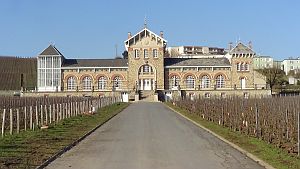 The search for an effective treatment went on vigorously not least in the research centre set up by Raoul Chandon de Briailles in Fort Chabrol near Epernay. Eventually it was realised that American vines, Vitis riparia or Vitis rupestris ,were immune, or at least resistant, to the predations of phlloxera and that by grafting French vines Vitis vinifera onto the American root stocks one could retain the characteristics of the European vines on a plant that would not succumb to phylloxera.
This then was the news for which everyone had been waiting for 40 years and a programme of replanting was soon undertaken, although it was interrupted by the First World War. Little by little between 1900 and 1938 the native vines were dug up and replaced by grafts using the American stocks until, on the eve of the Second World War, there were just 95 hectares of native vines remaining.
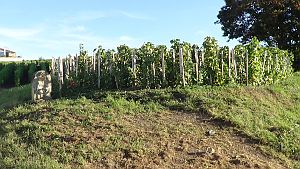 One good thing did come out of this terrible episode. Until the arrival of phylloxera vines grew very much at random (en foule – ‘in a crowd’ - as the method is called). The new vines were planted in rows as we see them nowadays. This allowed animals and later tractors to work the vineyards which did a great deal to make the life of a vineyard worker a lot easier.
They say that every cloud has a silver lining, but for the vignerons in Champagne it must has been hard to see it back in the early years of the 19th century.
Source material: article by Bruno Duteutre in Bulles et Millésimes http://www.champagne-news.com/1890-le-phylloxera-arrive-en-champagne/
 They say that if you wait long enough things come round in a circle and that seems to be true when it comes to trends in wine as well. Take champagne for example: a hundred years ago every champagne maker used oak barrels to age their wines, probably because they didn’t have many viable alternatives. Fast forwards a few decades and in the 1960s and 1970s almost everyone was throwing out their barrels and converting to stainless steel vats: purer, cleaner, easier to manage and, in short, the obvious way forward for any modern-minded champagne maker at that time.
 Apart from being the name of those flat-bottomed boats that you propel down the river with a pole, the term ‘punt’ also refers to the indentation that is found in the bottom of many wine bottles.
 If you’ve never heard of Champagne Jean-Noël Haton and think you’ve never tasted any champagne made by this company based in Damery in La Vallée de La Marne, you may well be mistaken. In fact Jean-Noël Haton may just be the best-known champagne that you’ve never heard of. Confused? Let me explain…
 There are at least two reasons for this remarkable growth and the most significant must surely be the drive and energy of the current head of the house: Jean-Noël himself. His idea of a quiet weekend is to spend the entire time driving a forklift truck to move pallet-loads of bottles to make more room in the storage area and in fact one could say that M. Haton’s work is also his pleasure. This would probably cause some friction in the family were it not for the fact that Jean Noel’s wife and son are also heavily involved in running the business, so despite the growth over the years Champagne Jean Noël Haton is still very much a family affair.
 Now before you start thinking to yourself that champagne sold in big chain stores under their own label is not the best quality, think again. You have only to look at the medals and other awards that are regularly bestowed on own-label brands to see that nothing could be further from the truth. In fact these buyers can be some of the most demanding of all, but even they could not fail to be impressed with the winery in Damery; just one glance shows you that this is a serious operation. State-of-the-art buildings housing row upon row of new stainless steel, temperature controlled vats and not a speck of dirt, or dust to be seen anywhere. Even the hoses which are essential in every winery but which more often than not are left in disarray, are neatly rolled up or arranged in line at Champagne Jean-Noël Haton, yet another piece of evidence that Monsieur Haton runs a tight ship.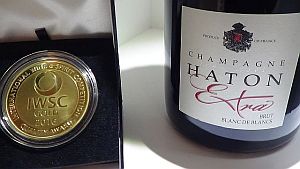
 Add to this the fact that you’re sure of a very warm welcome from the team in Damery if you visit the maison and it’s safe to say that you’re sure of a great experience if you ever have the opportunity to try the champagnes from this dynamic, but (as yet) little-known house.
 You can tell immediately that the harvest is in full swing in Champagne. One tell-tale sign is the rash of white vans that appears all over the vineyards (OK there are a few grey ones too, but there are so many white vans that one suspects that Champagne is keeping the whole white van manufacturing business going)
 Finally, I can’t resist telling you two quick stories about a champagne maker I know who has a mischievous sense of humour and who delights in pulling the wool over the eyes of people who should know better. On one occasion he bought some white vinegar at the local supermarket and put it in the fridge the night before a tasting with some prominent journalists. The next day he served the vinegar, ice cold, as the first wine to be tasted. There were several comments about the ‘wine’ being too cold, a bit rough, or too young, or green, but only one taster suggested that it wasn’t really wine at all.